
The Rich History of Money: 20 Intriguing Facts About Currency
“Money may be the husk of many things, but not the kernel. It brings you food, but not appetite; medicine, but not health; acquaintances, but not friends; servants, but not faithfulness; days of joy, but not peace and happiness.” - Henrik Ibsen
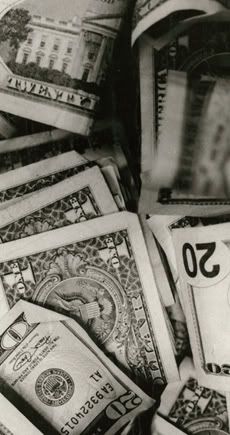 Photo by borman818Money is one of those necessary evils that we can't live without, yet sometimes focus on too greatly as a source for happiness. Yes, we all need it to survive, but in the end, it's just our device for paying for goods and services. Because it is a subject that none of us can avoid, I thought it would be fun to provide some historical facts about money.
- Egyptians first began collecting taxes almost 5,000 years ago, beginning with offering goods and labor as their way of paying the tax. This became much easier when Egypt and Mesopotamia started using silver and gold bars as currency, around 2500 B.C.
- Founded in Italy in 1472, and originally a pawnshop, Banca Monte dei Paschi di Siena, is the world's oldest surviving bank.
- Paper money originated in China in the year 910 and amazed Marco Polo when he visited there three centuries later. Kublai Khan was known for over-printing notes and this eventually caused inflation to skyrocket. Paper bills were abolished in China in the 15th century.
- The cost of the U.S. Civil War inspired the U.S. government to introduce paper "green-backs" in July of 1861.
- The first paper notes were printed in denominations of 1 cent, 5 cents, 25 cents, and 50 cents.
- Low-denomination U.S. bills don't have a very long life-expectancy. A $1 bill lasts 18 months; $5 bill, two years; $10 bill, three years; $20 bill, four years; and $50 and $100 bills, nine years.
- All of the U.S. coins and bills in general circulation today have a total worth of about $829 billion and two-thirds of that cash is held overseas.
- In a 2008 study, researchers found more cocaine residue on U.S. bills than on any other currency. They also discovered fecal matter and staphylococcus. Because of the filthiness of money, there was a time around 1916 in Washington D.C. when you could have your money washed, ironed, and reissued.
- The paper used in U.S. bills is made of 75% cotton and 25% linen; it is NOT made from trees. Red and blue synthetic fibers of various lengths are distributed evenly throughout the paper. Before World War I these fibers were made of silk.
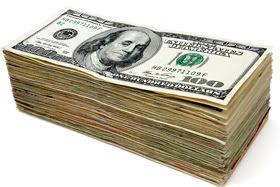 Photo by AMagill
- The U.S. Bureau of Engraving and Printing produces 38 million notes a day with a face value of approximately $541 million. That doesn't mean there is $541 million more money circulating today than there was yesterday, though, because 95% of the notes printed each year are used to replace notes already in circulation.
- The latest $5 bill design has an embedded security thread that contains more than 650,000 tiny glass domes, which create an optical illusion that the U.S. Mint hopes will make it hard to counterfeit.
- About half of U.S. bills (48 %) printed by the Bureau of Engraving and Printing are $1 notes.
- Martha Washington is the only woman whose portrait has appeared on a U.S. currency note. It appeared on the face of the $1 Silver Certificate of 1886 and 1891, and the back of the $1 Silver Certificate of 1896.
- U.S. bills measure 2.61 inches wide by 6.14 inches long, and the thickness is 0.0043 inches. Larger sized notes in circulation before 1929 measured 3.125 inches by 7.4218 inches.
- Paper money bears the signatures of four African American men who served as Registers of the Treasury (Blanche K. Bruce, Judson W. Lyons, William T. Vernon, and James C. Napier) and one African American woman who served as Treasurer of the United States (Azie Taylor Morton). No portraits of African Americans have appeared on paper money, but commemorative coins were issued in the 1940s bearing the images of George Washington Carver and Booker T. Washington, followed more recently by the release of a Jackie Robinson coin.
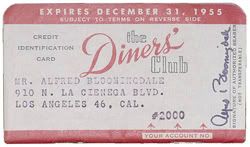
- In 1949, Frank X. McNamara took friends to dinner in New York City, but forgot to bring his cash. He vowed never to be embarrassed like that again, so he created the first credit card, the Diners Club Card. It was initially made of cardboard and listed 14 participating restaurants on the back. The original annual fee was just $3.
- The first ATM machine was built in 1967 by Scottish inventor, John Shepherd-Barron, for a Barclay's Bank in North London. He based the concept of the machine on a chocolate-bar dispenser. Because plastic cards did not yet exist, Shepherd-Barron's ATM accepted only checks laced with identifying traces of radioactive carbon-14. Once the radioactivity was detected, customers would enter their four-digit PIN numbers.
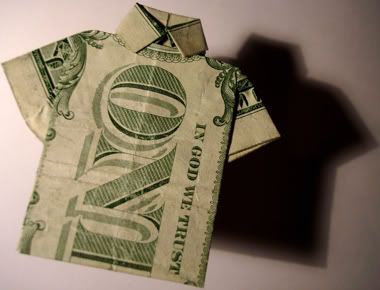 Photo by Rob Lee"He who is of the opinion that money will do everything, may well be suspected of doing everything for money." - Benjamin Franklin
 Friday, May 15, 2009 at 9:24AM