Do, Re, Mi, Fa, So, La, Ti, Do
Do, Re, Mi, Fa, So, La, Ti, Do was the work of Italian musician and singing teacher Guido d'Arezzo, developed toward the end of the 10th century, and forms the basis of the modern system of musical notation. In about 1040, this inspired genius devised the Guido scale, or Artinian syllables, that still sing his praises. The names he gave to the musical notes of the scale are still used today in modified form (do, re, mi, fa sol, la).
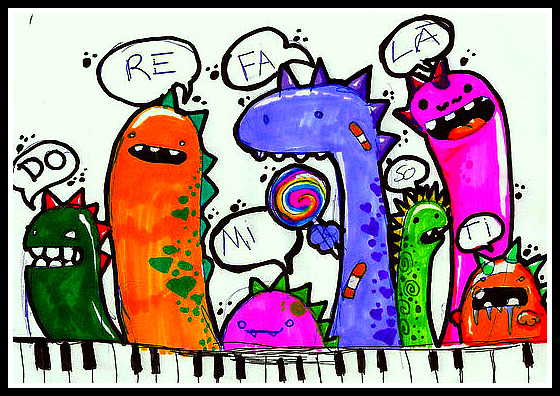 Art by Karurie
The Benedictine monk based them on six lines of a Latin hymn to St. John the Baptist, which happened to form the scale. Over the years, the final syllable ti was added to the scale and two centuries ago the syllable do joined it in English.
Solfeggio is the English word, taken from the Italian, to describe the musical exercise sung with Guido's scale.
And of course there is this famous rendition in The Sound of Music to help us all to remember the notation:
Do, a deer a female deer
re, a drop of golden sun
mi, a name I call myself
Fa, a long long way to run
so, a needle pulling thread
la, a note to follow so
te, a drink with jam and bread
and that brings up back to do....
